Collectors chase clean cards, but not every clean-looking card is clean in the way it should be.
Some sellers attempt to artificially improve condition through pressing, trimming, polishing or recoloring.
These tricks can fool beginners, but they leave fingerprints that graders and experienced collectors can detect.
Once you know what those signs look like, altered cards become impossible to miss.
Here’s how to identify them.
Why Alterations Happen
Money is the motivation. A card that jumps from “worn” to “sharp” can gain significantly in value, which makes altering tempting for unethical sellers.
Vintage cards, patch autos, rare parallels and modern cards with huge upside are the most commonly altered. The higher the price ceiling, the higher the odds someone tried to “fix” it.
Pressed Cards: The Surface Tells the Story
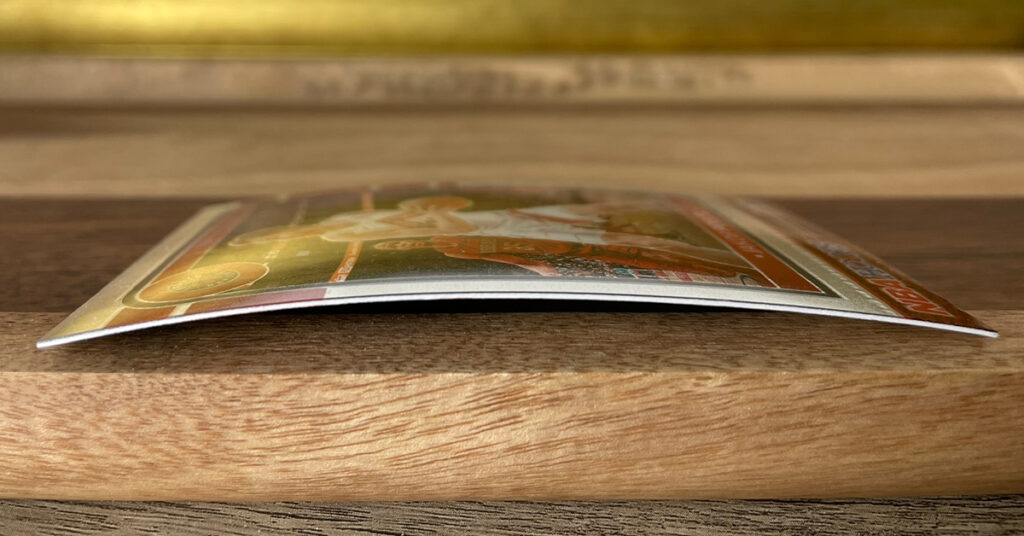
Pressing is flattening a card to hide bends, warping and corner lift. The card looks flatter, but it doesn’t look natural.
Pressed cards often have gloss that no longer reflects cleanly. When tilted under light, reflections appear broken or inconsistent. Corners may appear sharper than a card of that age and wear should realistically have.
The surface feels too smooth, lacking the factory texture.
A pressed card looks clean… but not right.
Trimmed Cards: The Edges Give It Away
Trimming removes small amounts of the edge to eliminate chipping or whitening. It sharpens appearance, but it permanently changes the card’s shape.
Trimmed cards are often slightly undersized. They look sharp but sterile, missing the factory cut signature. Corners may look pointed when they should have a micro-radius. Once you see trimming once, you’ll spot it forever.
Authentic edges are never razor-perfect.
Surface Cleaning: When Gloss Loses Its Identity
Polishing or wiping a card is usually done to hide scratches or smooth scuffs. The issue is that factory gloss is calibrated — and once it’s disturbed, the original look disappears.
Cleaned cards have shine, but not factory shine. Under lighting, the reflection skips, dulls or shifts unevenly. You may also see micro-wipe marks or texture changes. The card might look great in still photos, but in person the gloss doesn’t behave naturally.
Once you’ve seen untouched gloss, you’ll always notice altered gloss.
Recolored Edges: Ink Never Lies
Recoloring is used to mask white chipping or edge damage. It sounds minor, but it’s a big alteration.
Recolored edges almost never match perfectly. The shade can be darker, the tone appears uneven, or the ink bleeds into paper fibers. Corners especially will show inconsistencies because they’re the hardest to match.
Natural color transitions. Recolor always stands out.
Why Graders Catch It
Grading teams see more of the same card than anyone. They know what size, gloss, corners, edges and fiber structure should look like.
Altered cards get hit with labels like:
- Altered
- Evidence of trimming
- Pressed
- Minimum size requirement
Once a card gets that designation, resale value drops hard.
Why Original Always Wins
Collectors care more about authenticity than artificial perfection.
A truly original PSA 6 is more desirable than a suspicious-looking PSA 8.
Because original cards are stable in value. Altered cards never are.
Once a card has been messed with, it’s no longer “that card.” It’s a project someone tried to fix.
FAQ
Does pressing always get detected?
Yes. The surface gloss and internal structure almost always reveal it.
Can trimming ever be missed by grading?
Rarely. Even slight dimensional differences expose trimming.
Are cleaned cards always obvious?
In good lighting they are. Photos can hide it. In-person handling doesn’t.
Can recoloring ever pass as factory?
No. Factory ink is uniform. Recolor never matches perfectly.
Should I ever buy an altered card?
Only if the price reflects the alteration clearly, and never with grading plans.