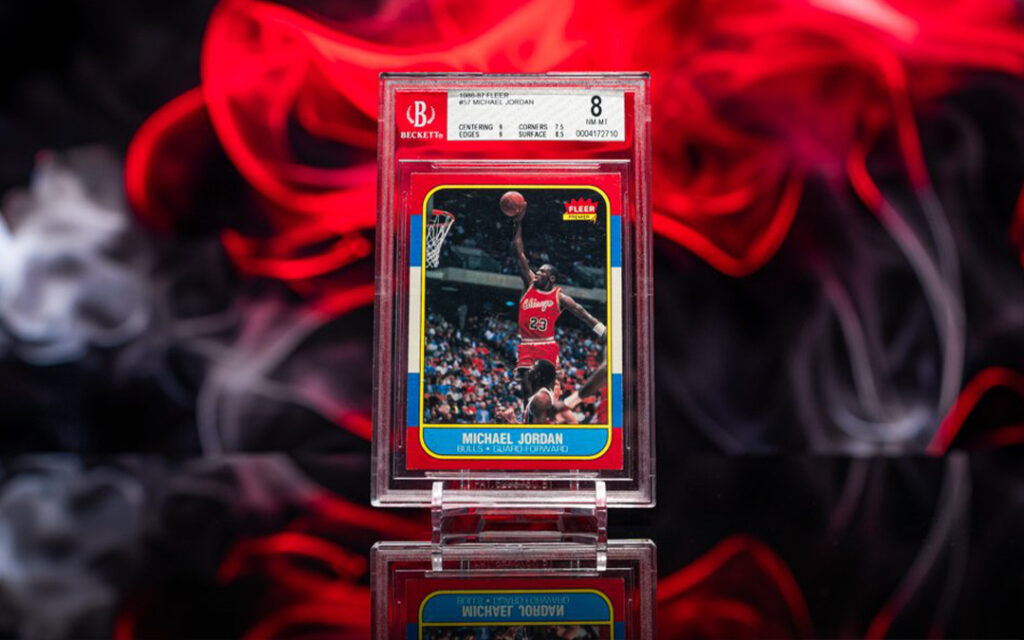
The 1986 Fleer Michael Jordan rookie is one of the most recognizable and counterfeited cards in the hobby.
High grade copies have sold for tens of thousands of dollars, which means scammers put a lot of effort into making fakes that look convincing at first glance.
The good news is that you do not need a lab or special equipment to protect yourself.
A good smartphone camera, a basic magnifying glass or a jeweler’s loupe and some knowledge of how real 1986 Fleer cards are printed will take you a long way.
Start With the Right Tools
Before you even look at a Jordan, get these in place:
- Good smartphone camera with the ability to focus close and zoom
- Magnifying glass or jeweler’s loupe
- Cheaper 1986 Fleer commons to compare stock, colors and gloss
Those cheaper Fleer 86 cards are your best training tool. Get familiar with how the gloss looks, how the colors pop, how the print dots sit in the ink and how the back stock naturally ages.
Once your eyes get used to genuine 86 Fleer, fake Jordans become much easier to spot.
Also keep in mind that many online photos are too soft or too far away.
If you cannot zoom in and clearly see print dots on the back bottom red area, you cannot authenticate the card properly.
Anyone in a comment section who confidently calls something real or fake from a blurry photo is guessing.
Big Picture Red Flags
Before the microscopic stuff, step back and ask:
Is the price unrealistically low compared to current comps?
For a card this iconic, a raw copy listed far below market value is almost always trouble. Good deals exist, miracle steals almost never do.
Is the seller providing sharp closeups?
If they refuse to provide high quality zoomed images of the back bottom red area, the NBA logos and the Fleer logo, assume they do not want you to look too closely.
Does the card look “inkjet” or watery in person?
Many fakes have that computer printed, slightly washed look. Lines are not crisp, colors bleed into each other and the print lacks the sharp dot patterns of real 80s offset printing.
If any of those are off, you should already be cautious before spending more time.
Front of the Card: Gloss, Logo and Borders
1. Surface Gloss
Real 1986 Fleer fronts have a distinct glossy shine when you tilt them toward a light.
The reflection tends to form a more concentrated “ball” of light.
On many computer-printed fakes:
- The shine is weaker or spread out
- The reflection is more diffuse rather than a focused glare
- The surface can look a bit waxy or “flat” instead of crisp and glassy
Use a lamp or strong overhead light and tilt the card slowly. Compare it to another genuine 86 Fleer card.
2. Fleer Logo and Yellow Arrow
The Fleer logo in the upper right corner is one of the most important areas to study.
On a real 1986 Fleer Jordan:
- The yellow arrow is a darker, more golden yellow than the “PREMIER” banner
- The tip of the arrow stops just short of the top of the banner, leaving a small gap
- The FLEER letters have sharp square corners, not rounded or bloated
- “FLEER” and “PREMIER” are almost perfectly aligned vertically at the left edge
On many fakes:
- Arrow and banner are the same shade of yellow
- Arrow touches or passes above the top of the banner
- “FLEER” font looks fatter, softer or slightly misaligned
You can also look very closely at the arrow and at the darker part of the yellow ribbon where it meets the Fleer logo. Real cards show red print dots inside those yellow shapes. Fakes often miss this detail or have random, messy dots.
Authentic Michael Jordan Rookie Card – Front


Fake Michael Jordan Rookie Card – Front


3. Borders and Color Transitions
The front border is another major check:
- The transition between blue and red should be crisp and clearly defined on a genuine card
- Counterfeits often have a fuzzy, smudged transition between those colors
Under magnification:
- The thin black border should be solid black ink, not made up of scattered dots or pixels
- The blue stripes in the border have darker tone in part because they include red print dots mixed in
- The white, red and yellow borders are solid colors that meet cleanly. The colors stop where they should, with only the occasional stray print dot crossing over
If the borders look muddy, overly grainy or “digital”, you are probably dealing with a fake.


4. Nameplate and Photo Print
On the real Jordan:
- The nameplate background is a light blue that is a consistent shade across genuine 86 Fleer cards
- The white letters of “Michael Jordan” have a sharp edge against that blue background
Reprints and fakes often show:
- A nameplate that is too dark a blue or a noticeably different shade from other 86 Fleer cards
- “Michael Jordan” that looks fuzzy or has a blurred transition between white and blue
- A general “graininess” or washed look in the photo, especially when you zoom in
In the photo itself, real printing uses different dot patterns for different colors.
Darker colors often show overlapping dot circles that can look like diamond patterns, while simple colors like red or yellow use more uniform checkerboard halftones.
Inkjet style dots that look random and watery are a bad sign.

Authentic Michael Jordan Rookie Card – Nameplate

Fake Michael Jordan Rookie Card – Nameplate

Back of the Card: Where Fakes Usually Fail
The back is where you win or lose the authenticity game.
Most counterfeits cannot copy the 1986 Fleer back perfectly, and your phone camera is your best friend here.
Authentic Michael Jordan Rookie Card – Back

Fake Michael Jordan Rookie Card – Back

1. Paper Color and Aging
Real 1986 Fleer backs rarely look bright white. They usually have:
- A slightly darker off white or yellowish tone
- The look of aged 80s paper stock, not modern bright copier paper
A perfectly bright modern white back should make you suspicious, especially if you are comparing it to a stack of genuine 80s cards.
2. Font Color and Wording
On a genuine Jordan:
- All back text is printed in dark blue ink, not black
- The licensing line reads “(C) FLEER CORP. PHILA. 19141 PRINTED IN U.S.A.” with correct punctuation and all caps
- The headings like YEAR, CLUB, PRO TOTALS and other stat labels are bold blue
- The actual numerical stats are not bold
Common fake tells:
- Text that looks pure black instead of blue
- Wrong capitalization, missing punctuation or spelling errors
- A mix of blue and black fonts where it should all be uniform blue
Take a clear closeup photo and zoom all the way in. Blue versus black is obvious once you enlarge it.
3. Print Dots in the Bottom Red Panel
(Most important check)
The most reliable tell is the print dot pattern in the light red area at the bottom of the back.
On a real 1986 Fleer Jordan:
- The bottom red area has an ordered, comic book style dot pattern
- Dots are evenly spaced and consistent in size
- Dots appear only where there is color. White areas are just paper, not dotted
On many computer-printed fakes:
- The dots are random, jumbled, different sizes and lack a clear pattern
- There are dots in areas that are supposed to be white, which means the printer laid color across the whole card, white included
- The result is that white areas look darker compared to a real 86 Fleer, since they are not true unprinted paper
The top red strip on the back and the blue Fleer logo on the upper left should look like solid color blocks under magnification, not dotted.
The top red is usually a darker red than the bottom red, which has a slightly faded look to the naked eye.
Do not be fooled if the bottom red looks a bit patchy or like it has light “splotches”.
That can still be correct on a genuine card.
You cannot reliably see these print dot differences with the naked eye. Use:
- A very close smartphone photo of the back bottom red section
- Or a magnifying glass or jeweler’s loupe
If you are buying online, ask for a high resolution closeup of that bottom back red area. If the seller cannot or will not provide it, walk away.

4. NBA Logo on the Right
At the bottom right on the back is the NBA logo inside the basketball.
On a real card, when you zoom in:
- You will see fine lines inside the basketball
- You can read the words around it: “NATIONAL BASKETBALL PLAYERS ASSOCIATION”
- Inside the ball it says “NBA” and below that “PLAYERS”
To the naked eye, those lines can be hard or impossible to see, even on real cards, so you must zoom.
Fakes often miss this fine detail completely or print the ball as a solid shape.

5. NBA Logo on the Left and Other Details
Using a loupe or magnifier, check the NBA logo on the bottom left:
- You should see the registered trademark (R in a circle)
- There should be red print dots in the middle of the NBA figure
- The phrase “OFFICIAL LICENSED PRODUCT(S)” is in all caps

Also confirm:
- The lettering in the name and stats is solid blue, never black
- The info line under the name before the stats is all caps
- Red highlight areas show uniform red print dots that are a lighter shade than the bottom panel
Forgers often slip on these small typographical details.
Missing punctuation, wrong slash placement or random capitalization issues are a huge red flag.
Authentic Michael Jordan Rookie Card – Back Bulls Logo

Fake Michael Jordan Rookie Card – Back Bulls Logo

6. The Decimal Point Myth
You will often hear people say that if the decimal point in the scoring average (“27.2”) is missing on the back, the card is fake.
It is true that many counterfeit cards do not show that period.
However:
- Some fake cards do have the decimal printed
- Printing issues on real cards are also possible
So treat the decimal point as one small clue, not a final verdict. Focus far more on the print dots, font color and other detailed checks in this guide.
Card Size and General Feel
Another easy check is to compare the Jordan to another 1986 Fleer card:
- The fake reviewed in your notes was slightly longer and slimmer than a real 86 Fleer
- The card stock on genuine 86 Fleer has a particular stiffness and feel that becomes obvious once you have handled enough of them
If the size is off even a little when aligned with a genuine Fleer from the set, that is a strong warning sign.
Official Reprints, “RP” and Illegal Knockoffs
There is only one official Jordan rookie reprint from Fleer that looks similar to the 1986 design:
- 1996 “Decade of Excellence”
- Features gold lettering “Decade of Excellence” on the front
- Back clearly states it was made in 1996, not 1986
That card has value of its own, but it is not the original rookie. People often list it online without clearly stating it is the 1996 card.
Any other “reprint” that:
- Still says 1986 on the back
- Was not produced by Fleer in a different year
- Or is only labeled “RP” or “reprint” by a seller
is either an unlicensed knockoff or at best a novelty card. If it says “RP” it is already telling you it is not a real 86 Fleer rookie, no matter how nice it looks.
Buying Raw Online: When to Walk Away
In the current market, buying an ungraded Jordan rookie online is extremely risky. If you insist on trying, here are strict rules that will save you a lot of pain:
- Demand sharp closeups
Ask for highly detailed photos of:- Front Fleer logo and yellow arrow
- Front nameplate and borders
- Back bottom red area
- Both NBA logos
- Do not trust only one distant image
Most listings do not give enough detail to see print dots or fine text. If all you see is a nice looking card from arm’s length, you are guessing. - Avoid brand new or low feedback accounts
Especially on platforms with a lot of casual sellers and scammers. Your notes mention Mercari as a particular minefield for raw cards over 100 dollars. - Prefer platforms with authentication
On eBay, for example, “authenticity guarantee” provides some protection because the card goes through an inspection process before it reaches you. - Listen to the story, but trust the card
A story like “it was my dad’s card since the 80s” is helpful context, but it does not override the print and stock checks. A sweet story with bad dots is still a fake.
Realistically, for most collectors the safer path now is to avoid buying raw Jordans online entirely unless you are extremely confident in your eye and the seller.
Graded Cards: Slab Tampering and PSA Holders
Graded cards were once seen as a safety net, but counterfeiters have evolved.
They now crack open slabs, swap cards and re-seal holders with fake labels, especially on high value cards like the Jordan rookie.
Key points:
- Older PSA holders can be pried open, which causes “frosting” on the edges of the slab when it is re-sealed
- Look at the security nubs under the label. If a holder has been tampered with, these nubs may be “mushroomed” or distorted
- Fake flips (labels) often reuse a real certification number, but use slightly different fonts, spacing and alignment than genuine PSA labels
PSA has gone through many generations of holders and flips. The current “lighthouse” label (generation 10) is considered the most secure.
When you buy a graded Jordan:
- Inspect both the card and the holder
- Compare the flip style and fonts with known good examples from the same PSA generation
- Prefer newer PSA lighthouse holders or strong slabs from Beckett and SGC
- Buy from reputable auction houses and established dealers whenever possible
Even then, you should still perform the same visual checks on the card inside the slab.
Grading is a strong layer of protection, not an absolute guarantee.
Quick Checklist Before You Buy
Use this quick summary when you are holding a Jordan rookie in your hand or staring at a listing:
- Front gloss
- Focused, strong shine when tilted
- Fleer logo and arrow
- Arrow darker than banner
- Small gap above “PREMIER”
- “FLEER” with sharp corners and correct alignment
- Borders and nameplate
- Crisp color transitions
- Solid black border under magnification
- Light blue nameplate, not overly dark or fuzzy
- Back stock and fonts
- Slightly aged off white paper
- Dark blue text, not black
- Correct all caps wording and punctuation
- Print dots on back bottom red
- Ordered, comic style halftone
- No dots in white areas
- Top back red and back Fleer logo are solid blocks, not dotted
- NBA logos
- Right logo shows ball lines and readable text when zoomed
- Left logo has clear (R), red dots in figure, correct wording
- Size and feel
- Same size and thickness as other 1986 Fleer cards
- Price and seller
- Price is in line with current comps
- Seller can provide clear closeups or you can inspect in person
If a card passes all of those tests, your odds are good. If it fails even a few, it is probably not worth the risk.
The 1986 Fleer Michael Jordan rookie is an incredible card to own, but it attracts every kind of forgery.
Take your time, study real 86 Fleer commons and use your phone or loupe to force every card to answer the hard questions.
With practice, you will be able to separate real from fake with confidence and enjoy the card for what it is meant to be.